Tethertonium
Series: alt.ctrl activities; builds on Gametrak and Trautonium; Spatial arrangement
With a conductive fingerboard, and conductive thread attached to a tether, the Gametrak's footswitch input can time touches accurately. Together they simulate a trautonium.
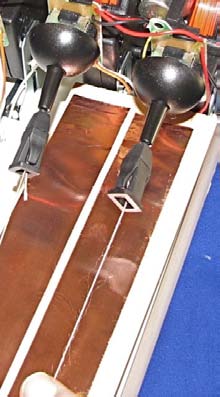
Materials
| Item | Amazon | eBay |
|---|---|---|
| A Gametrak controller, with its footswitch input | search | |
| Conductive thread | ||
| A conductive fingerboard (in the paper's photograph, copper-coloured strips) | ||
| A computer with Max/MSP or Pd |
Tools
- Tools not yet listed.
Skills
- Skills not yet listed.
Instructions
- Set the Gametrak up as in Set Up a Gametrak for Music.
- Lay the conductive fingerboard under the tether's path.
- Attach conductive thread to the tether where it crosses the fingerboard.
- Wire the thread and the fingerboard to the footswitch input, so that pressing the thread onto the fingerboard closes it, as the footswitch would.
- Which contacts of the footswitch input to use: not yet written.
- Map the readings to sound: for example, the tether's extension to pitch, with touches starting and stopping notes in time.
Variations
- Variations not yet written.
Related resources
- Musical Applications and Design Techniques for the Gametrak Tethered Spatial Position Controller, Freed and others, SMC 2009, section 4.7
- Trautonium (Wikipedia)
- Favorite eTextile Materials, for conductive thread
Coding Prompt Build Block
A prompt to give a coding assistant, to start the code for this activity. Copy the box, answer its questions about your board and pins, and test what comes back on the bench before you rely on it.
I am building "Tethertonium", the activity at https://adrianfreed.com/tethertonium.html.
Write a Max or Pd patch, or a program, for a Gametrak whose tether carries conductive thread that closes the footswitch input when it is pressed onto a conductive fingerboard.
Map the tether's extension to pitch, and start and stop notes with the footswitch input, in time with the touches.
Libraries to explore:
- o.io.gametrak (CNMAT MMJ Depot): CNMAT's Max patch for the Gametrak: it opens the device and outputs /left/x, /left/y, /left/z, /right/x, /right/y, /right/z and /footswitch, the angles scaled from -1 to 1 and the extensions from 0 to 1 (https://github.com/CNMAT/CNMAT-MMJ-Depot/tree/master/patchers/io/gametrak)
- odot (CNMAT): the o. objects for Max and Pd that o.io.gametrak is built from, with OSC bundles as their data type (https://github.com/CNMAT/CNMAT-odot)
- Max hi object: reads human interface devices, such as game controllers, in Max (https://docs.cycling74.com/reference/hi/)
- Pd hid external: reads USB HID devices, such as joysticks and gamepads, in Pd, on GNU/Linux and macOS (https://github.com/pd-externals/hid)
Before writing anything, ask me what I am using: the board and its pins, or the software (such as Max, Pd or Python), and check its documentation for what this needs. Put the pin numbers, ranges and other settings in one block at the top, each with a comment. Say which of the libraries above you use, and why. Start with a test that shows the raw readings, so that I can check the wiring and the ranges before the rest.
This activity by Adrian Freed is licensed under Creative Commons Attribution-NonCommercial-ShareAlike 4.0 International (CC BY-NC-SA 4.0): you may share and adapt it with attribution, for non-commercial purposes such as personal projects and teaching, and you must share adaptations under the same licence. Product names and links belong to their suppliers.